
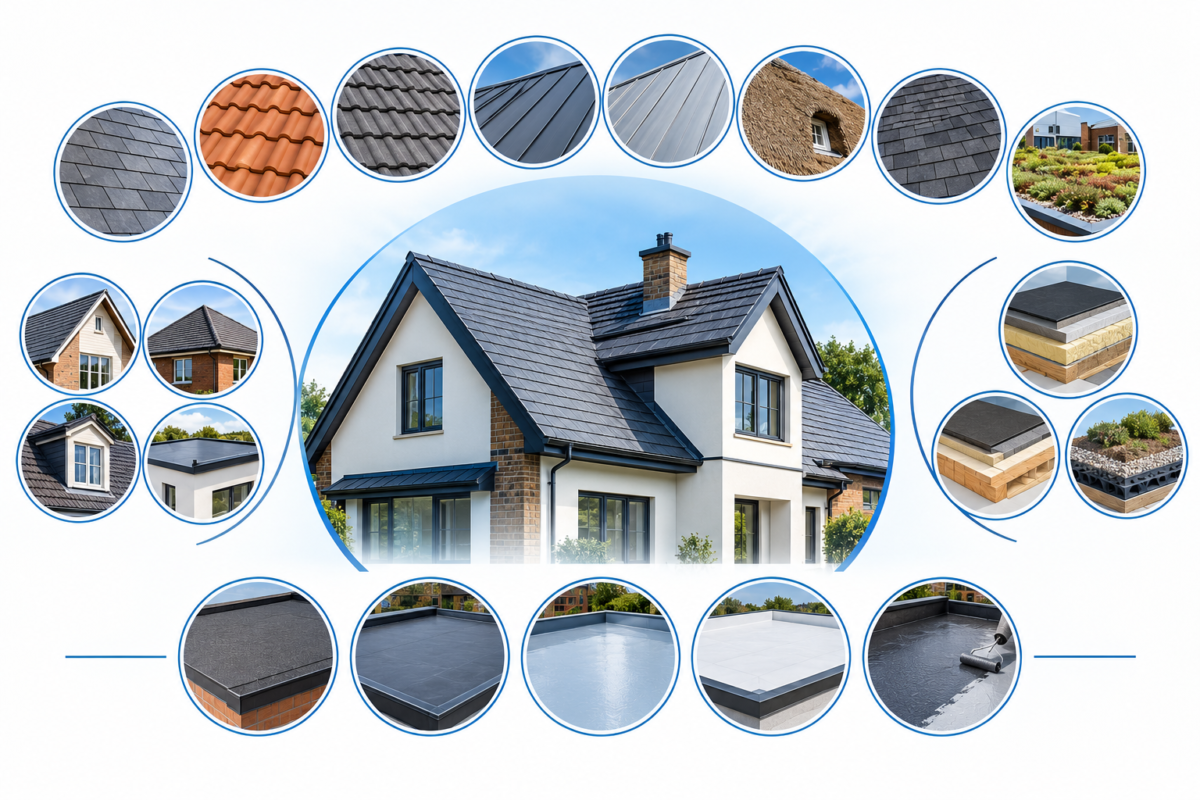
Roofs are classified in three ways: by shape (gable, hip, mansard, lean-to, butterfly and more), by covering (concrete tile, clay tile, natural slate, thatch, metal, felt, EPDM, GRP and more) and by construction (warm roof, cold roof, inverted roof). Most UK homes have a pitched gable or hipped roof covered in concrete tiles, clay tiles or natural slate, while extensions, garages and dormers usually have a flat roof in EPDM, GRP or felt. Below, we explain the different types of roofs, their pros, cons, lifespan and best uses from a roofer’s point of view.
Need advice on your own roof? Get a free, no-obligation quote from BestWay Roofing or call +448000487912.
Why Your Roof Type Matters
Your roof does far more than sit on top of the house. It keeps out rain, wind, frost and summer heat, and it affects insulation, ventilation, energy bills and how the property looks from the street.
After 30 years of roofing across Chelmsford, Braintree and Ipswich, we see the same pattern again and again: the right roof type for a property saves money and problems for decades, and the wrong one causes leaks, condensation and early replacement.
The choice affects two things at once:
- Upfront cost: Slate, clay and metal cost more to install than concrete tiles or felt.
- Long-term cost: A premium roof that lasts 60 years often works out cheaper than a budget roof replaced twice.
Some materials are built to last for generations. Others are a sensible, affordable choice for an extension, garage or outbuilding. Some suit steep pitched roofs, and others are made for low-pitch or completely flat roofs. This guide is written for homeowners, landlords, developers and commercial property owners who want to make an informed decision.
Understanding the Main Types of Roofing
All roofs fall into two broad groups: pitched roofing and flat roofing. Within each group, three choices decide the final roof: the shape, the covering and the construction (how the layers are built up).
Pitched roofs
A pitched roof has a clear slope, so rainwater runs naturally into the gutters. It is the classic look of British homes and can be covered in slate, clay tiles, concrete tiles, metal, thatch or composite products. Typical pitch is between 22.5° and 45°.
Flat roofs
A flat roof has a much lower pitch and is common on extensions, garages, dormers, balconies and commercial buildings. Despite the name, it always needs a slight fall (at least 1:40) so water drains to an outlet. It is waterproofed with a membrane such as felt, EPDM, GRP or single ply.
If you are deciding between the two designs for an extension, garage or new build, our guide to flat roofs and pitched roofs compared explains the differences in cost, drainage, maintenance and practical use.
How the three choices fit together
| Classification | What it tells you | Examples |
|---|---|---|
| 01Shape | What does the roof look like? | Gable, hipped, mansard, lean-to, flat |
| 02Covering | What keeps the weather out? | Slate, clay tile, concrete tile, EPDM, GRP |
| 03Construction | How are the layers built? | Warm roof, cold roof, inverted roof |
The roofing material you choose depends mostly on the shape, pitch and structure of your roof. The sections below cover each covering in turn, then the shapes and the construction types.
Different Types of Roofs at a Glance
Use these two tables as a quick index. Pick a shape (how the roof is built) and a covering or system (what keeps the weather out); every shape can take several coverings. Full detail on every type follows below.
Roof shapes
| Roof shape | Where you’ll see it | Best for |
|---|---|---|
| Gable | Most UK houses | Simple design, lower cost and good loft space |
| Hipped | Bungalows, detached homes | Windy or exposed sites |
| Half-hip (jerkinhead) | Cottages, Victorian and Edwardian homes | Period appearance with added wind resistance |
| Cross-gable / cross-hipped | L-shaped and T-shaped houses | Complex floor plans |
| Dutch gable | Traditional and period homes | A decorative gable above a hipped roof |
| Mansard | Town houses, loft conversions | Maximising additional living space |
| Gambrel | Barns and barn conversions | Wide, high loft or storage space |
| Lean-to / mono-pitch | Extensions, porches, garden rooms | A single slope against or alongside a wall |
| Catslide | Cottages and 1930s homes | A long roof slope extending low on one side |
| Butterfly | Modern architect-designed homes | Central rainwater collection and high windows |
| Pyramid | Porches, towers, garden buildings | Small square buildings |
| Dormer | Loft conversions | Additional headroom and natural light |
| Barrel vault / curved | Modern and commercial buildings | A distinctive architectural shape |
| Flat | Extensions, garages, balconies | Low-profile covering for extensions and wider spans |
Roof coverings and systems
| Covering or system | Lifespan | Typical fitted cost (2026) | Best for |
|---|---|---|---|
| Concrete tiles | 40–60 years | £85–£150/m² | Most modern homes |
| Clay plain tiles | 60–100 years | £110–£210/m² | Period homes, colour retention |
| Clay pantiles / interlocking clay | 60–100 years | £100–£180/m² | East Anglian and coastal styles |
| Natural slate | 75–100+ years | £140–£280/m² | Premium roofs, conservation areas |
| Fibre cement / synthetic slate | 25–50 years | £95–£185/m² | Slate appearance on a budget |
| Stone slate | 80–100+ years | Specialist quote | Listed and Cotswold-style buildings |
| Timber shingles | 25–40 years | Surveyed quote | Churches, outbuildings, garden rooms |
| Thatch | 25–60 years | £10,000–£30,000+ per re-thatch | Historic cottages |
| Standing seam metal (zinc, aluminium) | 40–100 years | £150–£260/m² | Modern and architectural roofs |
| Lead | 60–100+ years | £150–£270/m² | Flashings, valleys, flat roofs, dormers |
| Profiled steel sheeting | 25–40 years | Surveyed quote | Garages, barns, outbuildings |
| EPDM rubber | 30–50 years | £60–£120/m² | Flat roofs, extensions |
| GRP fibreglass | 25–30+ years | £70–£130/m² | Flat roofs, balconies |
| High-performance felt | 15–25 years | £50–£100/m² | Budget flat roofs |
| Liquid-applied coating | 15–25 years | £60–£150/m² | Existing flat-roof refurbishment |
| PVC / TPO single-ply | 25–35 years | £100–£150/m² | Larger and commercial flat roofs |
| Mastic asphalt | 30–50 years | Surveyed quote | Heavy-duty and traditional flat roofs |
| Green / sedum roof | 40+ years | £50–£150/m² | Eco-friendly garages and extensions |
Please note: Guide prices for England, 2026, supply and fit for a straightforward roof, excluding VAT. Scaffolding, a new deck, insulation and complex details are extra. Prices in Chelmsford and the East of England often sit in the middle to upper part of these ranges, so a surveyed quote is the only accurate figure.
Pitched Roof Coverings: Slate, Clay, Concrete, Metal and More
The covering is the visible layer of a pitched roof. It decides the look, the weight on the structure, the lifespan and the cost. Every covering has a minimum pitch, and fitting the wrong product on a low pitch is a classic cause of leaks.
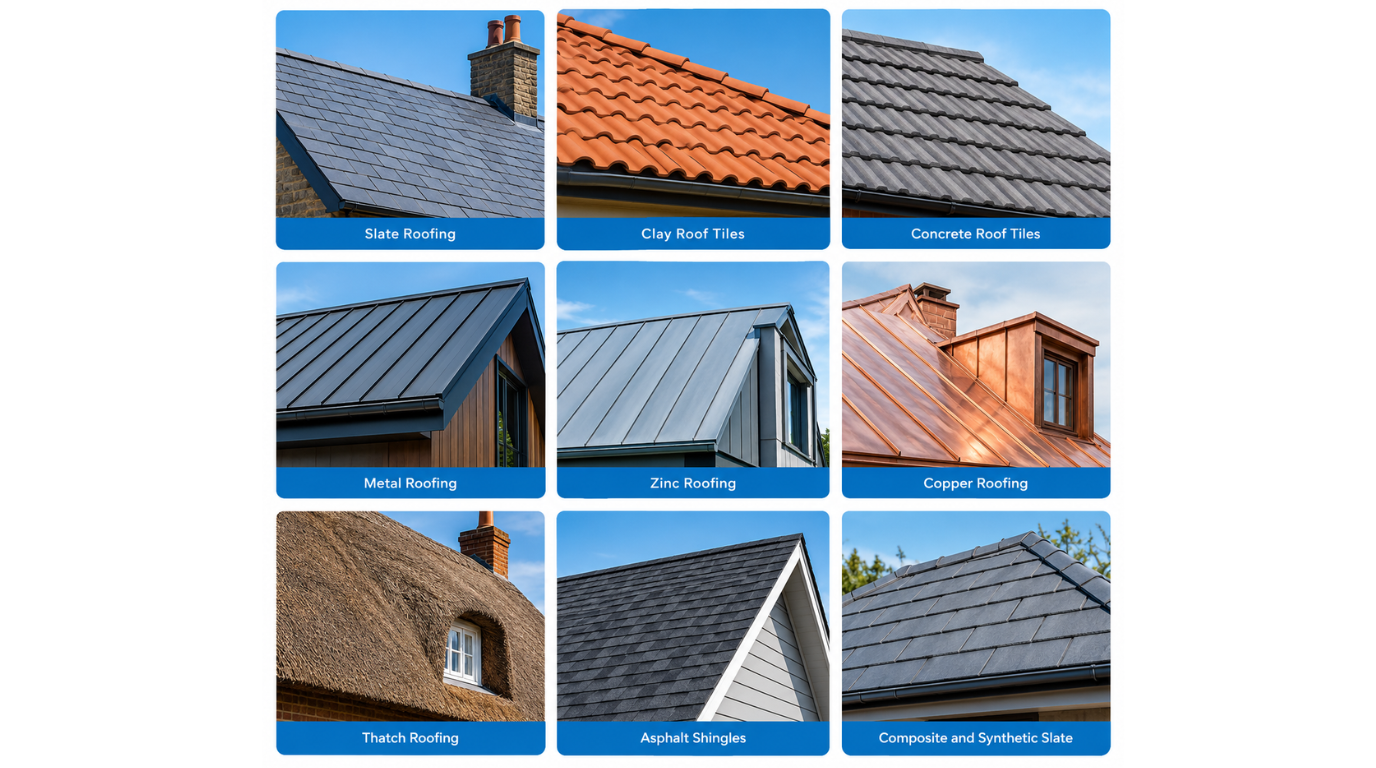
1. Slate Roofing
Natural slate is quarried stone split into thin sheets and laid in overlapping courses. Welsh, Spanish and Brazilian slate are all used in the UK. It suits period homes, cottages, Victorian terraces and conservation areas.
Lifespan: 75–100+ years. Typical cost: £140–£280 per m² fitted. Best for: Period and premium homes.
Benefits of slate roofing
- Longest service life of any common covering
- Very low water absorption and strong frost resistance
- Fire resistant
- Attractive natural finish in many colours and textures
- Minimal routine maintenance
Things to consider: Higher material and labour cost than concrete tiles, and the weight means the roof structure must be checked. Cheap imported slate varies in quality, so the source matters.
2. Clay Roof Tiles
Clay tiles are made from natural clay, shaped and fired at high temperatures, which gives a hard, weather-resistant tile. They have been used on British buildings for centuries. The main styles are plain clay tiles and pantiles (S-shaped, a feature of East Anglia).
Lifespan: 60–100 years. Typical cost: £110–£210 per m² fitted. Best for: Traditional homes, Essex and Suffolk streets, conservation areas.
Benefits of clay roof tiles
- Excellent durability and weather resistance
- Colour is baked in, so it does not fade
- Resistant to rot and insect damage
- Good character that improves with age
- Low maintenance
Things to consider: More expensive than concrete tiles, though usually good long-term value.
3. Concrete Roof Tiles
The most widely used covering on modern UK homes. Concrete tiles are made from cement, sand and water, and come in interlocking, double Roman and plain profiles from makers such as Marley, Redland and Sandtoft. Many imitate the look of clay or slate.
Lifespan: 40–60 years. Typical cost: £85–£150 per m² fitted. Best for: Most houses built since the 1960s and re-roofing on a sensible budget.
Benefits of concrete roof tiles
- Lower cost than natural slate and premium clay
- Wide choice of profiles, colours and finishes
- Strong weather protection
- Easy to source, and familiar to every roofing contractor
- Suit most pitched roofs
Things to consider: Heavier than some alternatives, and the surface colour can fade and collect moss over time.
4. Metal Roofing
Metal roofing is increasingly common on homes, extensions and commercial buildings. Materials include steel, aluminium, zinc and copper. Modern systems look nothing like the old corrugated sheets seen on farm buildings, and standing seam metal is popular on contemporary architecture.
Lifespan: 40–100 years depending on the metal. Typical cost: £150–£260 per m² fitted for standing seam. Best for: Modern homes, low-pitch roofs and extensions.
Benefits of metal roofing
- Long lifespan
- Lightweight, so it suits lighter structures
- Excellent weather resistance and fast water run-off
- Low maintenance
- Recyclable at end of life
Things to consider: It must be designed and fitted to control condensation, noise and thermal movement.
5. Zinc Roofing
Zinc is a favourite for contemporary houses and architectural projects. It forms a natural protective patina over time, which helps it resist corrosion, and it is easy to shape into curves and detailed features.
Lifespan: 60–80+ years. Typical cost: £150–£260 per m² fitted for standing seam. Best for: Modern builds, dormers, curved roofs and premium extensions.
Benefits of zinc roofing
- Self-protecting patina
- Suits unusual shapes and architectural details
- Very low maintenance
- Long life that offsets the higher initial price
Things to consider: Higher upfront cost, and it needs a specialist installer.
6. Copper Roofing
Copper is another premium metal. New copper is bright and shiny, then slowly weathers to brown and eventually the green patina seen on many historic buildings. It is extremely durable and can be formed around complex details.
Lifespan: 100+ years. Typical cost: Priced on survey, and usually above zinc. Best for: Feature roofs, bay windows, dormers, turrets and high-end projects.
Benefits of copper roofing
- Exceptional durability
- Can be shaped around complex details
- Distinctive colour that changes over time
Things to consider: Cost is the main drawback, so it is more common on features than on whole house roofs.
7. Thatched Roofing
Thatch is one of the oldest roofing methods still used in Britain. Water reed, combed wheat reed and long straw are the traditional materials, and thatch is most often found on cottages, historic homes and listed buildings.
Lifespan: 25–60 years depending on material. Typical cost: £10,000–£22,000 for a full re-thatch in long straw or combed wheat reed, and £16,000–£30,000+ in water reed. Best for: Historic cottages and listed properties.
Benefits of thatched roofing
- Outstanding visual character
- Natural insulation
- Made from renewable, natural materials
Things to consider: It needs a specialist thatcher, regular maintenance, and careful planning for fire safety, insurance and local planning restrictions.
8. Asphalt Shingles
Asphalt shingles are very common in North America and less so on mainstream UK houses. They do appear on garden offices, cabins, sheds, outbuildings and some small developments.
Lifespan: 15–30 years. Typical cost: From about £15 per m² for the shingles alone, plus fitting. Best for: Outbuildings and light structures.
Benefits of asphalt shingles
- Lightweight
- Straightforward to install
- Low cost
Things to consider: They do not give the traditional British look of slate or clay and have a shorter lifespan.
9. Composite and Synthetic Slate
Composite roofing products combine recycled plastics, polymers, minerals or fibre cement to copy the look of slate or tile. They are useful where you want the appearance of slate without its weight and cost.
Lifespan: 25–50 years. Typical cost: £95–£185 per m² fitted. Best for: Budget-conscious re-roofs and roofs with limited structural capacity.
Benefits of composite roofing
- Slate look at lower weight and cost
- Quick to install
- Available in many colours
Things to consider: Quality varies between manufacturers, so always check the specification, guarantee and relevant standards before you buy.
Flat Roof Systems: Felt, EPDM, GRP, Single Ply and More
Flat roofs are used on extensions, garages, dormers, porches, balconies and commercial buildings. They are waterproofed with a continuous membrane rather than individual tiles, and they always need a fall of at least 1:40 so water drains away.
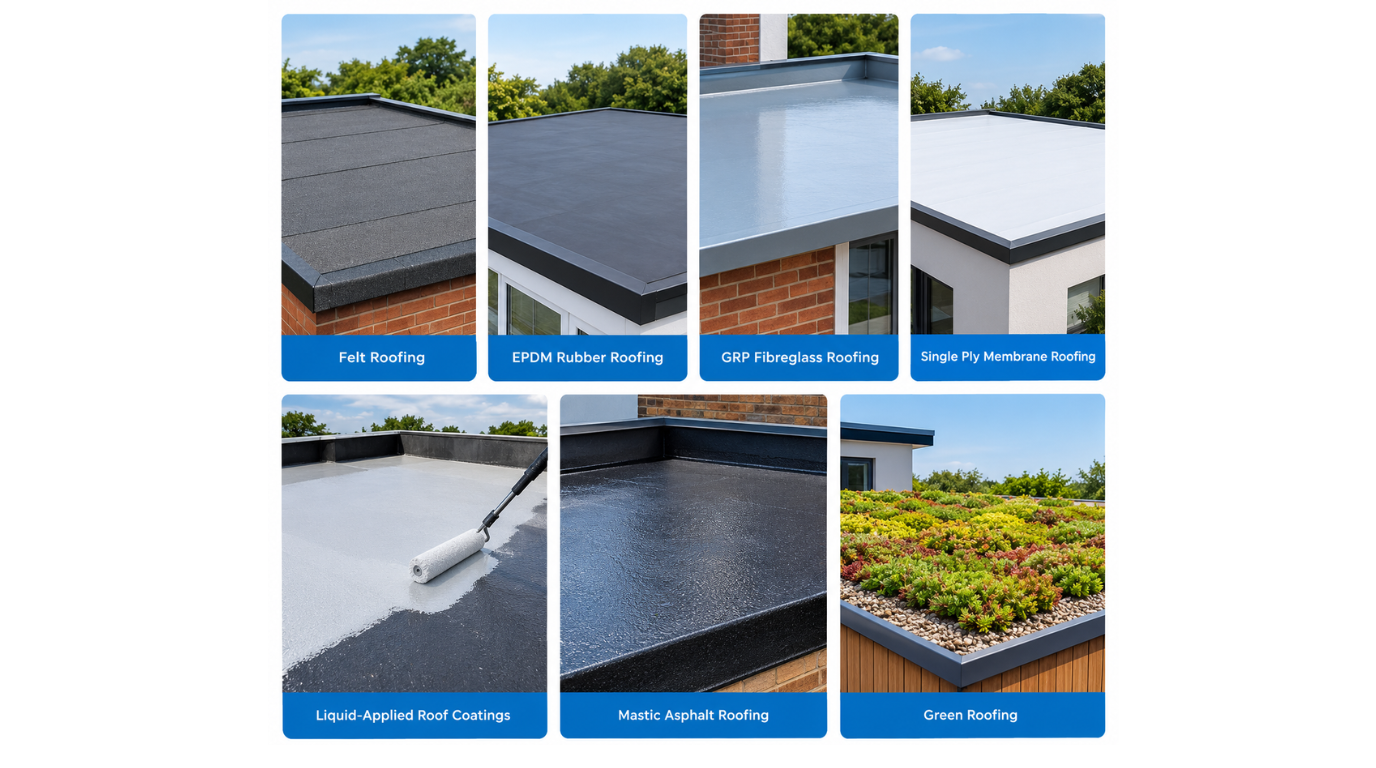
10. Felt Roofing
Felt has long been the most common flat roof material. Modern systems use several layers of reinforced bitumen membrane bonded together, and are very different from the thin shed felt many people picture. Options include torch-on felt, cold-applied felt and self-adhesive felt.
Lifespan: 15–25 years. Typical cost: £50–£100 per m² fitted. Best for: Garages, extensions, porches, garden buildings and budget flat roofs.
Benefits of felt roofing
- Lowest upfront cost of the main flat roof systems
- Widely available and familiar to every roofer
- Reliable waterproofing when installed in multiple layers
- Suits small and awkward roof shapes
Things to consider: Shorter lifespan than rubber or fibreglass. Torch-on work uses heat, so safe working practice is essential.
11. EPDM Rubber Roofing
EPDM stands for ethylene propylene diene monomer. It is a synthetic rubber membrane, and one sheet can often cover a whole roof, which removes most joints where leaks could start.
Lifespan: 30–50 years. Typical cost: £60–£120 per m² fitted. Best for: Residential extensions, garages and small to medium flat roofs.
Benefits of EPDM roofing
- Strong waterproofing with very few seams
- Flexible through hot and cold weather
- Good UV resistance
- Lightweight
- Low maintenance and resistant to cracking
Things to consider: Careful detailing is needed at roof edges, outlets, rooflights and penetrations. It is not built for regular foot traffic unless a walkway is added.
12. GRP Fibreglass Roofing
GRP stands for glass-reinforced plastic, usually called fibreglass roofing. Fibreglass matting and resin are applied over a prepared deck and cure into a rigid, seamless, waterproof surface, finished with a coloured topcoat and neat edge trims.
Lifespan: 25–30+ years. Typical cost: £70–£130 per m² fitted. Best for: Small and medium roofs, balconies and walkable roof terraces.
Benefits of GRP roofing
- Seamless waterproof finish
- Clean, modern appearance
- Strong, walkable surface
- Good durability and low maintenance
- Handles detailed shapes and upstands well
Things to consider: It needs a sound, dry deck and the right temperature to cure. Poor installation conditions can cause cracking later.
13. Single Ply Membrane Roofing
Single ply roofs use flexible factory-made sheets of synthetic membrane, most often PVC or TPO, joined by heat-welded seams. They are widely used on commercial buildings and increasingly on homes.
Lifespan: 25–35 years. Typical cost: £100–£150 per m² fitted. Best for: Large flat or low-pitch roofs, flats, shops and commercial units.
Benefits of single ply roofing
- Efficient coverage with little added weight
- Quick installation
- Strong weather and UV resistance
- Flexible, with strong welded joints
Things to consider: Detailing around penetrations needs a trained installer.
14. Liquid-Applied Roof Coatings
A liquid membrane based on polyurethane, acrylic or bitumen is applied directly over an existing roof surface and cures into a seamless layer. It is ideal for refurbishing a tired flat roof without a full strip-out.
Lifespan: 15–25 years. Typical cost: £60–£150 per m² fitted. Best for: Roofs with many pipes, rooflights and awkward details.
Benefits of liquid-applied coatings
- Less disruption and no strip-out
- Seamless finish around complex details
- Quick repair of ageing roofs
Things to consider: The existing surface must be sound and dry, so it is not suitable for a roof that has already failed.
15. Mastic Asphalt Roofing
Mastic asphalt is a hot-applied, heavy-duty waterproofing layer used for decades on balconies, podiums and traditional flat roofs.
Lifespan: 30–50 years. Typical cost: Priced on survey, as it is specialist hot-applied work. Best for: Heavy-duty and walkable roofs, balconies and listed buildings.
Benefits of mastic asphalt
- Very durable and fully seamless
- Good for roofs with heavy use
- Long track record
Things to consider: It needs a skilled, specialist installer and hot working on site.
16. Green Roofing
Green roofs support vegetation over a waterproof roof. A typical build-up includes a waterproof membrane, a root barrier, a drainage layer, a growing medium and plants. Sedum is the usual choice because it copes with shallow soil.
Lifespan: 40+ years for the system. Typical cost: £50–£150 per m² for sedum and wildflower roofs, and £150 or more for roof gardens. Best for: Garages, extensions, garden offices and urban developments.
Benefits of green roofs
- Better biodiversity and support for insects and wildlife
- Rainwater management
- Extra insulation
- Lower surface temperatures
- Attractive natural appearance
Things to consider: Structural capacity, drainage and the waterproofing must be checked before installation.
The right membrane depends on your budget, roof design, insulation requirements and how the surface will be used. Our guide to flat roof materials compares the main options to help you narrow down a suitable system.
Which flat roof is best?
For most home extensions and garages, EPDM or GRP give the best mix of durability, finish and value. Felt suits the tightest budgets, liquid coatings suit refurbishment, and single ply suits larger roofs. Read more about our flat roofing services in Chelmsford.
Roof Shapes: Every Pitched Roof Type Explained
A pitched roof slopes at an angle, usually 22.5° to 45° on UK homes, so rain and snow run straight off. The shape is set by the carpentry (rafters or trusses), and any suitable tile, slate or metal covering can then go on top. Here is every shape we meet on the roof.
Gable roof (pitched roof)
Two slopes meeting at a central ridge, with a triangular wall (the gable) at each end. It is the most common roof in the UK.
- Pros: Simple and affordable, sheds water well, easy to ventilate, generous loft space.
- Cons: Gable ends can catch the wind, so verges need to be properly fixed and braced.
- Best for: Most semi-detached and detached houses.
Hipped roof
Four slopes, with no vertical gable wall. The sloping edges meet at hip lines, finished with hip tiles or lead.
- Pros: Very stable in high wind, balanced look, good protection for walls.
- Cons: More complex and more expensive to build and repair, with extra hips and valleys to seal.
- Best for: Bungalows, detached houses and exposed sites.
Half-hip (jerkinhead) roof
A gable whose top is clipped by a small hip. It gives a softer, cottage-style look and better wind resistance than a full gable.
- Best for: Victorian and Edwardian homes, cottages and some 1930s houses.
Cross-gable and cross-hipped roof
Two or more gable or hipped roofs joining at right angles to suit an L-shaped or T-shaped house. The joins create valleys, which are the most common leak point on these roofs, so lead or good-quality valley trays matter.
Dutch gable roof
A hipped roof with a small gable placed on top. It adds loft headroom and a decorative feature at the end wall.
Mansard roof
Two slopes on each side: a steep lower slope and a shallower upper one, often with dormer windows. It creates almost a full extra storey, which is why it is popular for loft conversions in towns.
- Pros: Maximum extra living space, distinctive appearance.
- Cons: Usually needs planning permission, and the many junctions need excellent detailing.
Gambrel roof
Similar to a mansard but with gable ends. It is a barn-style shape that gives a high, wide loft, and you will see it on barn conversions and outbuildings.
Lean-to (mono-pitch or skillion) roof
A single slope rising from a lower wall to a higher one. It is common on rear extensions, porches, garden rooms and conservatory replacements. Covering options include tiles, slate, lightweight tiled systems, standing seam metal and single-ply membranes.
Catslide roof
A pitched roof that sweeps down in one long slope, often to a single-storey height on one side. It is a classic of English cottages and many 1930s homes.
Butterfly roof
Two slopes angled inwards to form a “V” with a central valley. It allows high windows and rainwater harvesting, but the central gutter needs careful drainage design and regular checks.
Pyramid roof
A hipped roof where all four slopes meet at one point. It suits square buildings such as porches, garden rooms, summer houses and turrets.
Bonnet roof
A hipped roof with a slight kick or curve at the eaves, giving a wide overhang that shelters walls and windows.
Saltbox roof
A gable roof with one slope longer and lower than the other. It is a rare style in the UK, mostly seen on extended or period properties.
Dormer roofs
A dormer projects from a sloping roof to add headroom and a window. Common types are:
- Flat-roof dormer: The most common, the most space, and the simplest to build.
- Gabled dormer: A small pitched roof over the window, traditional in appearance.
- Hipped dormer: A small hipped roof, a good match for hipped main roofs.
- Shed dormer: A single sloping roof, giving the largest area of floor space.
- Eyebrow dormer: A low, curved roof with no sides, found on thatched and some cottage roofs.
Because dormers have many junctions, lead flashings and waterproofing quality decide how long they last.
Barrel vault and curved roofs
A continuous curve over the whole roof, usually in metal, single-ply or zinc. It suits modern extensions, garden buildings and commercial units.
A-frame, conical and other specialist shapes
A-frame roofs reach to the ground and are found on chalets and cabins. Conical roofs top turrets and round towers, and are usually slate, lead or tile. Both need a specialist roofer.
Roof Construction Types: Warm, Cold and Inverted
How a roof is built matters as much as what covers it, especially for insulation and condensation. Roof work must meet Building Regulations Part L (conservation of fuel and power), the 2021 edition that has applied to applications since 15 June 2022. A new or replacement roof should typically achieve a U-value of about 0.15 W/m²K. If you renovate more than 50% of a roof surface, or replace the waterproof layer of a flat roof, the insulation usually has to be upgraded too, to around 0.16–0.18 W/m²K depending on the roof type. Always confirm the figure with building control before work starts.
Structural rules sit in Part A, and good practice follows standards such as BS 5534 (tiling and slating) and BS 6229 (flat roofs).
Flat roof build-ups compared
| Roof build-up | Insulation position | Main benefit | Main risk |
|---|---|---|---|
| Warm roof | Above the deck, beneath the waterproof layer | +Keeps the structure warm and reduces condensation risk | !Slightly higher material cost |
| Cold roof | Between the joists, with a ventilated gap above | +Simple to install on existing joists | !Condensation if ventilation is inadequate |
| Inverted roof | Above the waterproof layer, protected by ballast or paving | +Protects the membrane and suits terraces | !Extra weight requires adequate structural capacity |
| Hybrid roof | Part above and part between the joists | +Helps meet thermal targets where depth is limited | !Requires careful design and vapour control |
We recommend the warm roof for most new flat roofs because it is the most reliable way to control condensation and meet current insulation standards.
Pitched roof construction types
- Cut roof (traditional rafters): Built on site from timber rafters, purlins and ridge boards. Gives open loft space and is typical of older homes and complex roofs.
- Trussed roof: Factory-made triangular trusses at regular spacing. Faster and cheaper, common on homes built since the 1960s, but the web members make loft conversions harder.
- Attic truss and room-in-roof: Specially designed trusses that leave a usable room in the loft.
- Insulated panel and SIP roofs: Factory-made insulated panels used on modern and timber-frame builds.
Ventilated and unventilated roofs
A cold pitched roof is insulated at ceiling level and relies on a ventilated loft. A warm pitched roof is insulated at rafter level, often with a breathable membrane. Both need the right ventilation detail, such as eaves vents, ridge vents or dry-ridge systems, to prevent damp and mould.
Underlay, battens and fixings
Under the covering, a breathable roofing underlay and correctly sized battens let moisture escape and carry the load of the tiles or slate. Modern dry ridge, dry verge and mechanical fixing systems also reduce mortar failure and help roofs resist storms.
Specialist and Modern Roof Types in 2026
These are the newer and specialist roofs we are asked about most.
- Solar roofs: Solar PV panels sit on top of an existing roof (on-roof) or replace tiles (in-roof and solar tiles). Fitting them is the best time to check your roof, because replacing tired tiles before the panels go on is far cheaper than removing the array later.
- Green and living roofs: Sedum or wildflower roofs for garages, extensions and garden offices, improving drainage and biodiversity.
- Lightweight tiled roof systems: A solid, insulated tiled roof on conservatories, orangeries and garden rooms, replacing glass or polycarbonate.
- Insulated solid conservatory roofs: A year-round upgrade that cuts heat loss and glare.
- Cool roofs and reflective coatings: Light-coloured membranes that reduce summer heat gain, useful on flats and commercial buildings.
- Rainwater harvesting roofs: Butterfly and flat roofs designed to collect and store rainwater.
- Dry-fix systems: Dry ridge, dry verge and dry valley fixings that avoid mortar and cut repair costs.
- Sustainable roofing: Reclaimed slate and clay, recycled-content membranes and longer-lasting systems that lower the lifetime impact of a roof.
- Heritage and listed building roofs: Like-for-like repair in clay, slate, stone slate or thatch, often needing listed building consent.
Unsure which roof suits your property?
Our team can survey your roof and talk you through the options.
How to Choose the Right Roof for Your Home
Here is how we help customers decide:
- Match the existing property. In period homes and conservation areas, like-for-like materials (often clay or natural slate) are usually expected.
- Check the roof structure. Heavier coverings such as natural stone or clay may need the rafters and trusses assessed.
- Think about pitch. Every tile and slate has a minimum pitch. Using the wrong product on a low pitch is a classic cause of leaks.
- Consider the whole life cost. A cheaper roof that lasts 20 years can cost more than a premium roof that lasts 60.
- Plan for insulation and ventilation. The roof should work as a system with the loft, so you do not trade a leak for condensation.
- Budget for details. Flashings, valleys, ridges, fascias and gutters often decide how well a roof performs. Our uPVC fascia and guttering service completes the roofline.
- Use a qualified roofer. Always ask for insurance details, written quotes, a clear scope of work and photos of previous projects.
FAQs
What type of roof lasts the longest?
Natural slate, clay tiles and lead or zinc metal roofs can all last 60–100 years or more when installed correctly and maintained.
How often should a roof be inspected?
At least once a year, and after severe weather. A quick check in autumn, before the storms, and again in spring helps catch faults early.
How do I choose a trustworthy roofer?
Look for local experience, public liability insurance, clear written quotes, genuine Google reviews and a portfolio of completed work. Beware of cold callers, “too good to be true” prices and anyone asking for large upfront cash payments.
