
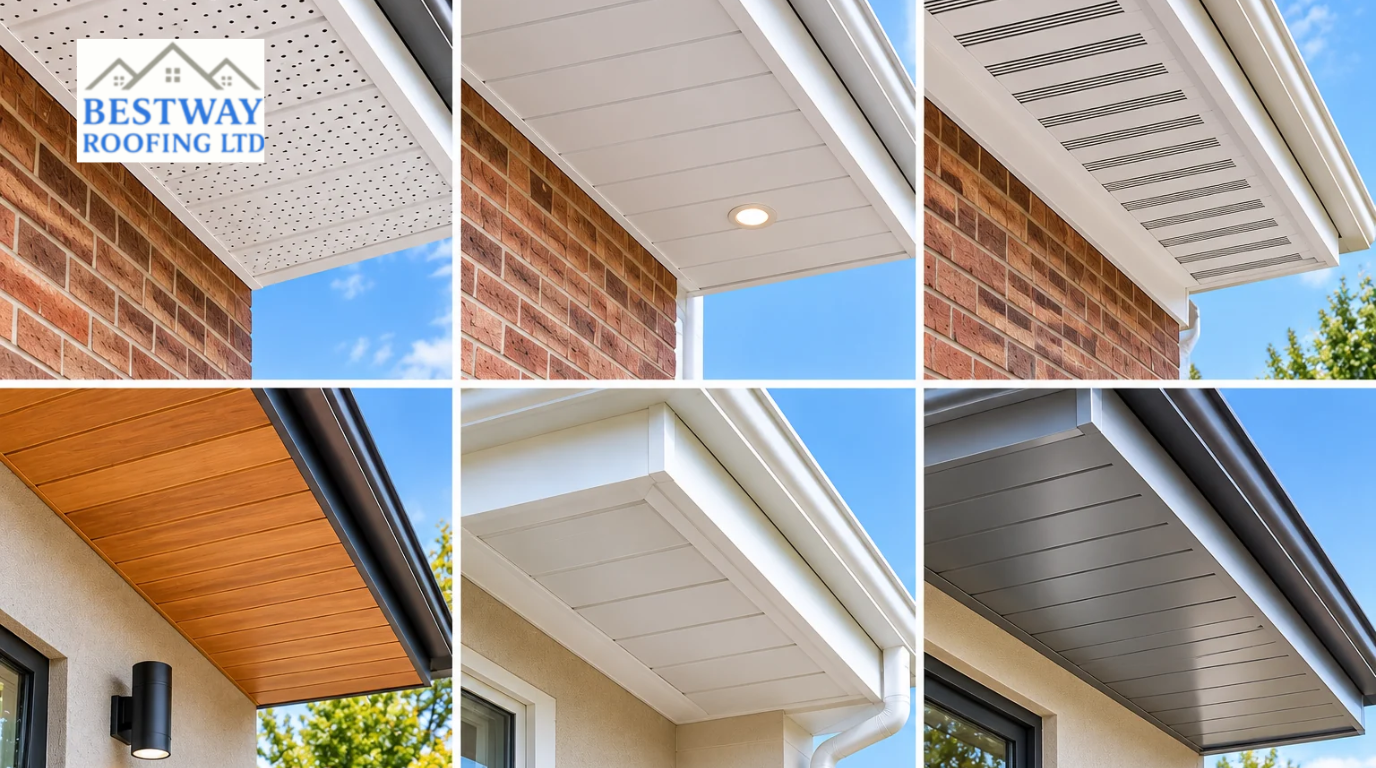
Soffits are categorised by material and ventilation style. By material, the main types are uPVC, timber, aluminium, composite, and vinyl; by ventilation style, they come as solid, vented, and hollow soffits. But choosing the wrong type can trap moisture in your loft and lead to costly repairs, so the right choice depends on your roof’s ventilation, your home’s style, and a few 2027 roofline trends most homeowners haven’t heard about yet.
In 2026, there are more soffit materials, finishes and ventilation options than ever. If you’ve been asking what the different types of soffits are, this guide covers every main type, with clear pros and cons, so you can choose the right one for your home.
What Is a Soffit?
A soffit is the horizontal board fixed to the underside of the roof overhang (the eaves). It closes the gap between the top of your external wall and the edge of the roof.
People often mix up soffits and fascias, but they do different jobs:
Soffit
Sits horizontally underneath the overhang and faces the ground.
Fascia
Sits vertically along the roof edge, faces outwards and holds the guttering.
Bargeboard
The angled board along the gable end of a pitched roof.
Together, these parts make up the roofline, and they work as one system.
Why Are Soffits Important?
A good soffit does several jobs at once:
- Protects the rafters: keeps rain, snow and wind-blown debris away from the roof timbers.
- Keeps pests out: stops birds, bats, wasps and rodents getting into the roof space.
- Lets the loft breathe: vented soffits let fresh air into the loft, which helps stop condensation, mould and timber rot.
- Keeps the property in good condition: a sealed roofline stops moisture getting into walls and loft insulation.
- Improves kerb appeal: a clean, matching roofline makes the whole house look tidier and better cared for.
Types of Soffits by Material
1. uPVC Soffit boards
uPVC is the most common soffit material in the UK and is widely used on new homes and replacement roofline projects. It doesn’t rot, warp or need painting, which suits the UK’s wet weather. It’s affordable, easy to clean, and comes in many colours and woodgrain finishes, making it the most practical choice for most homeowners.
✔ Pros
Affordable, low maintenance, weather-resistant, won’t rot or peel, and comes in a wide range of colours and finishes.
✘ Cons
Can look less traditional on period properties, and cheaper boards may fade or discolour over time.
2. Timber Soffit boards
Timber is the traditional soffit material and is still found on many older UK properties. It has a natural, classic look and can be painted any colour. It’s often required on listed buildings and in conservation areas, but it needs regular painting or treatment to prevent rot.
✔ Pros
Authentic, natural look; fully paintable in any colour; ideal for period and listed homes.
✘ Cons
Needs regular painting or treatment, can rot, crack or attract pests, and costs more to maintain over time.
3. Aluminium Soffit boards
Aluminium soffits are popular on modern homes and commercial buildings. They’re very strong, long-lasting and won’t rot or rust. They give a sleek, premium finish in many powder-coated colours. They cost more upfront but can last for decades with almost no upkeep. Heading into 2027, more mid-range UK homes are choosing aluminium for its sharp finish and long life.
✔ Pros
Very durable, rust- and rot-resistant, non-combustible, long-lasting, and with a sharp modern finish.
✘ Cons
Higher upfront cost, can dent if hit, and may be noisier in heavy rain or strong wind.
4. Composite and Fibre Cement Soffits
Composite and fibre cement soffits combine materials to add strength and weather resistance. They’re tough, resist impact well and perform well against fire. You can paint these boards or buy them pre-finished, but a professional roofer should always fit them.
✔ Pros
Very hard-wearing, impact-resistant, good fire performance, and available painted or pre-finished.
✘ Cons
Heavier and harder to cut, more expensive than uPVC, and needs professional installation.
5. Vinyl Soffit boards
Vinyl soffits are lightweight, affordable and very similar to uPVC. They’re widely used in North America and often come as perforated panels that let air flow into the loft. They’re quick to install and suit low-cost roofline projects.
✔ Pros
Budget-friendly, lightweight, quick to install, and often perforated for ventilation.
✘ Cons
Thinner boards may sag or warp in extreme heat or cold, and they’re less durable than uPVC or aluminium.
Types of Soffits by Design and Ventilation
1. Solid Soffits
Solid soffits are plain, flat boards with no ventilation holes and are the most popular all-round choice. They give a clean, smooth finish under the eaves. They work best when the loft is already ventilated through ridge, tile or over-fascia vents.
✔ Pros
Clean, smooth appearance; suits almost any property; easy to maintain; vents can be added later if needed.
✘ Cons
Gives no airflow on its own, so it can lead to condensation if the loft has no other ventilation.
2. Vented Soffits
Vented soffits have pre-cut holes or slots that let fresh air flow into the roof space. This airflow helps prevent condensation, mould and timber rot in the loft. They’re especially useful in homes with thick loft insulation and work best alongside ridge vents. With more homes adding thicker loft insulation, vented soffits are becoming a go-to choice for keeping roof spaces dry. If your soffits are already in place, you can add soffit vents later by cutting in round or strip vents, a common upgrade in UK homes.
✔ Pros
Prevents condensation, protects roof timbers from rot and mould, and works well with modern loft insulation.
✘ Cons
Vent holes can collect dust or cobwebs, and small insects may get in if the vents have no mesh.
3. Hollow Soffits
Hollow soffits are lightweight boards with a hollow core, usually made in a tongue-and-groove or shiplap style. Once fitted, they create a panelled, decorative look similar to traditional timber cladding. They’re ideal for wide overhangs, porches and canopies.
✔ Pros
Attractive panelled finish, lightweight, easy to install at height, and great for wide or deep overhangs.
✘ Cons
Costs slightly more than plain boards, and the joints can collect dirt, so they need occasional cleaning.
4. Decorative and Woodgrain Soffits
Decorative soffits are uPVC or composite boards finished with a woodgrain texture or colour foil. They give the warm look of real timber without the painting and upkeep. Many homeowners match them to their windows, doors and guttering for a coordinated exterior. Anthracite grey and black are likely to stay among the most popular roofline colours in 2027.
✔ Pros
Timber look without the maintenance, wide colour choice, and easy to match with windows and guttering.
✘ Cons
More expensive than plain white uPVC, and foil finishes can fade slightly after many years of strong sunlight.
5. Flush (Flewing) Soffits
Flewing soffits, also called flush soffits, sit tight against the wall with little or no roof overhang. They’re common on older terraced houses and narrow eaves where there isn’t room for a full boxed soffit. Narrow uPVC boards close the gap neatly.
Types of Soffits by Eaves Construction
1. Boxed (Closed) Soffit
A boxed soffit fully encloses the roof overhang, creating a neat box shape at the eaves. It’s the most common style on UK homes because it gives a tidy, finished look and strong protection against weather and pests. You can seal small gaps where the soffit meets the wall with an exterior sealant to keep out draughts and insects.
✔ Pros
Neat finish, fully enclosed against birds and insects, and gives good protection to roof timbers.
✘ Cons
Needs proper ventilation planning, as a fully enclosed box can trap moisture if it isn’t vented.
2. Sloped Soffit
A sloped soffit follows the angle of the rafters instead of sitting flat under the eaves. It’s often used on homes with deep overhangs or architectural roof designs, giving the roofline a more open, stylish look.
✔ Pros
Stylish, open appearance, suits deep overhangs, and still covers and protects the rafters.
✘ Cons
Harder to install than flat soffits and may cost more because it takes more labour.
3. Open Eaves (No Soffit)
Open eaves have no soffit board, so the rafter ends are left exposed under the roof. This style can look attractive on rustic, cottage-style or modern homes as a design feature.
✔ Pros
Rustic, natural look; shows off the roof structure; and provides plenty of natural airflow.
✘ Cons
Less protection from weather, birds and insects, and the exposed timbers need regular care and maintenance.
Comparison Table: Different Types of Soffits
Soffit Types at a Glance
| Soffit Type | Durability | Maintenance | Typical Lifespan* | Cost Level | Best For |
|---|---|---|---|---|---|
| uPVC | High | Very low | 20–30+ years | Low to mid | Most UK homes |
| Timber | Medium | High (painting/treatment) | 10–20 years with upkeep | Mid | Period and listed homes |
| Aluminium | Very high | Very low | 40+ years | High | Modern and commercial builds |
| Composite / Fibre Cement | Very high | Low | 30+ years | Mid to high | Fire-conscious, high-wear areas |
| Vinyl | Medium | Low | 15–25 years | Low | Budget projects |
| Solid (design) | – | Low | Depends on material | Low | Roofs ventilated elsewhere |
| Vented (design) | – | Low | Depends on material | Low to mid | Lofts prone to condensation |
| Hollow (design) | – | Low | Depends on material | Mid | Decorative finishes, deep overhangs |
Lifespans are typical estimates and depend on product quality, installation and exposure.
How to Choose the Right Type of Soffit
Before you choose, consider these questions. Getting them right now means your roofline will still look good and perform well long after 2027:
- How is your loft ventilated? If you don’t have ventilation elsewhere, vented soffits are usually the right choice. If ridge or tile vents already provide airflow, solid soffits work fine.
- What style is your property? Period homes often suit timber or woodgrain finishes. Modern homes look sharp with aluminium or anthracite uPVC.
- How much maintenance do you want? If you never want to paint again, choose uPVC or aluminium.
- What’s your budget? uPVC gives the best value. Aluminium and composite cost more upfront but last longer.
- Are there planning or conservation rules? Listed buildings and conservation areas may require like-for-like timber replacement.
- Should you replace the fascias at the same time? It’s usually cheaper and neater to replace soffits, fascias and gutters together.
Signs Your Soffits Need Replacing
Look out for these warning signs:
- Peeling paint, flaking or soft, crumbly timber
- Cracks, gaps or boards sagging away from the wall
- Damp patches or mould in the loft
- Birds, wasps or rodents getting in at the eaves
- Water staining on external walls below the roofline
- Discoloured or brittle uPVC
Soffit damage often comes from problems with the gutters above. If water overflows or drips from failing gutter joints, it can soak the fascia and soffit boards and speed up rot. If your soffits are already damaged, our guide on installing soffit boards and fascias explains how new boards are fitted and what to expect.
How Soffits Are Changing for Modern Homes
Soffits aren’t just plain white boards any more. As homes become more energy-efficient and homeowners expect longer-lasting materials, the way soffits are chosen and fitted is changing. Here’s what’s shaping the roofline in the year ahead:
- Ventilation comes first: vented soffits are becoming standard as loft insulation gets thicker.
- Darker colours are popular: anthracite grey, black and slate are replacing plain white.
- Aluminium is reaching more homes: more mid-range homeowners now choose it for its long life.
- Fire safety matters more: fire-rated and non-combustible materials are in higher demand.
- Greener materials are growing: recycled uPVC with longer guarantees is now widely available.
- Full upgrades replace patch repairs: homeowners are replacing the whole roofline in one job.
Conclusion
Soffits are easy to overlook, but they protect your roof timbers, keep out pests and help your loft breathe. The main types are uPVC, timber, aluminium, composite and vinyl by material, and solid, vented and hollow by design. Each has its own strengths, and the right choice depends on your property’s ventilation, style, budget and how much upkeep you want.
For most UK homeowners, uPVC soffits give the best mix of durability, low maintenance and value. Vented boards are the safer choice when loft condensation is a concern. Period properties may still need timber, and modern homes increasingly suit aluminium and dark finishes. These trends are set to grow through 2027.
If your soffits are rotting, cracked or letting in pests, don’t wait for the damage to reach your roof structure. Bestway Roofing Chelmsford Roofing offers professional UPVC fascia and guttering services and can inspect your roofline, recommend the right soffit type for your home, and fit a neat, long-lasting finish. Get in touch today for a free quote and protect your home for years to come.
FAQs
How are soffits attached?
Soffit boards are fixed to the underside of the rafter feet or to timber bearers, usually with stainless steel nails or screws. One edge slots into a groove behind the fascia board, and the other rests against the wall.
What is the most common type of soffit in the UK?
uPVC is the most common soffit material in the UK. It’s affordable, doesn’t rot and needs almost no maintenance.
What is the difference between vented and solid soffits?
Vented soffits have holes or slots that let air into the loft to reduce condensation. Solid soffits are plain boards with no airflow and are used when the roof is ventilated another way.
Do I need vented soffits?
Not always. If your loft has no other ventilation, or you notice condensation or mould up there, vented soffits are strongly recommended. A roofing professional can check what your roof needs.
